

How to Prep a Yard for Artificial Turf (The Part That Actually Matters)
Base prep is 80% of an artificial turf install. What proper prep looks like, what shortcuts fail, and how to spot a shortcut installer before you sign.
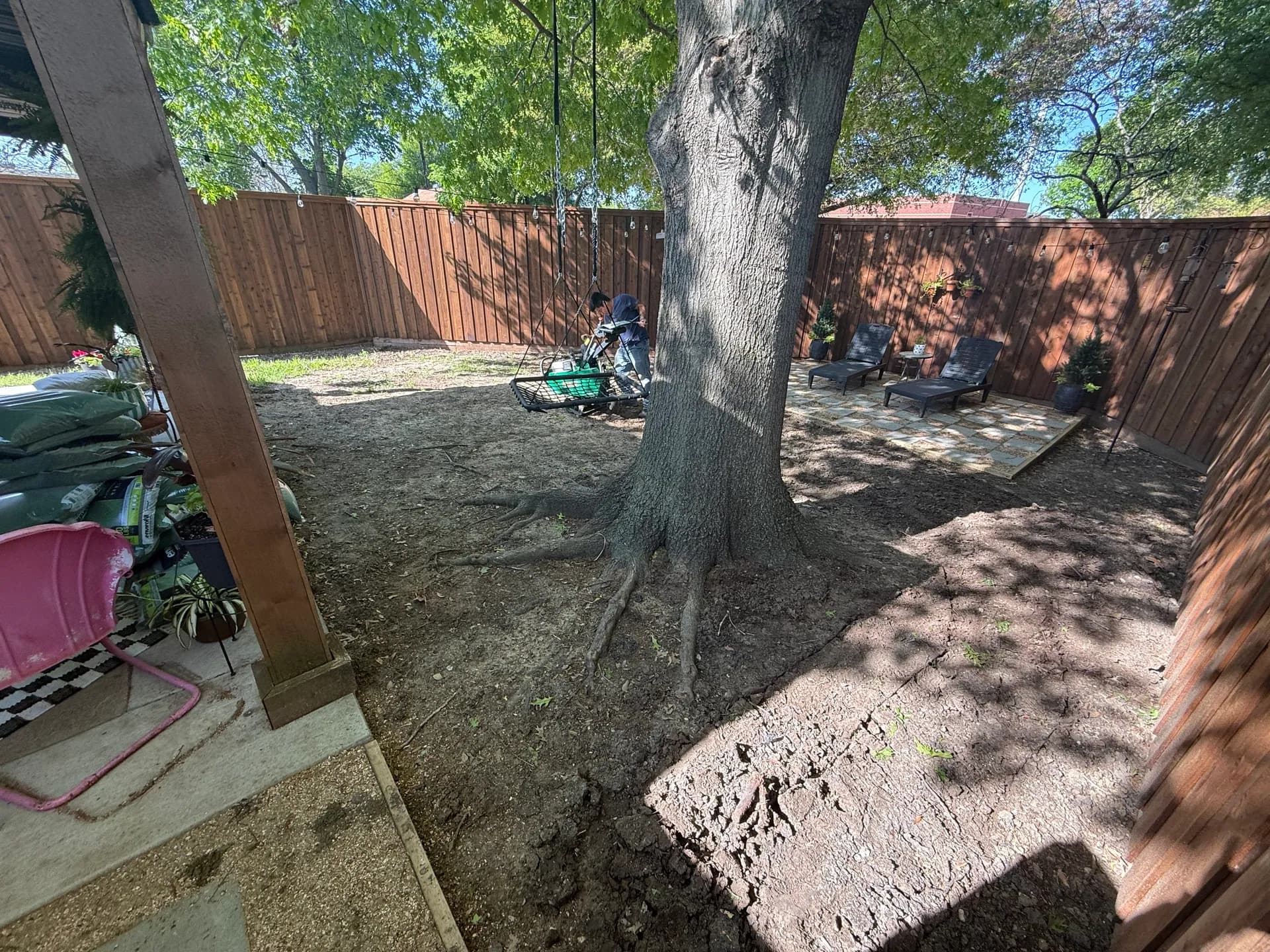
Every artificial turf install lives or dies on base prep. The pretty green stuff on top is the easy part. Here's what we actually do — and what you should ask about before signing a turf contract.
Why Base Prep Matters So Much
An artificial turf system sits on a compacted aggregate base. If the base shifts, settles, or drains poorly, the turf on top:
- Develops low spots and puddles
- Shows wrinkles and seam pulls
- Fails prematurely at wear points
- Holds pet odor (drainage matters)
A shortcut base saves a few hundred dollars and costs the install five years of life.
Step 1 — Remove Existing Vegetation and Soil
We strip grass, sod, roots, and 3–4 inches of topsoil. That's non-negotiable — turf installed over live soil eventually settles as organic matter decomposes.
For yards with heavy tree roots, we grind or excavate around major root systems and rebuild the base around them.
Step 2 — Grade and Contour
The sub-base should drain away from the house at 1–2% slope minimum. We grade the excavated area to:
- Maintain house drainage (no negative slope toward the foundation)
- Eliminate bowls or low points where water collects
- Blend to adjacent grass, hardscape, or fence lines
This is where shortcut installers cut corners. A flat-as-possible "good enough" grade becomes the puddle after the first heavy rain.
Step 3 — Install the Aggregate Base
We use crushed decomposed granite or a 1/4" minus base rock, 3–4 inches deep for landscape applications and 4–6 inches for pet-heavy or high-traffic zones.
- Aggregate laid in 2-inch lifts
- Each lift compacted with a plate compactor to 90%+ density
- Final grade smooth within 1/4" tolerance over 10 feet
Mid-install lift compaction is the difference between a hard, stable base and one that shifts six months in.
Step 4 — Add Pet or Shock-Pad Layer (If Applicable)
Pet installs get a specialized permeable layer on top of the base — drains urine through to the gravel below and keeps the turf surface clean. Antimicrobial infill goes on top of the turf.
Playground installs get a closed-cell shock pad under the turf for fall-height safety ratings.
Step 5 — Weed Barrier
A commercial-grade geotextile weed barrier goes over the finished base. Stops anything organic from pushing up through the turf.
Cheap weed barrier degrades in 3–4 years and nutgrass punches through. We spec heavy-duty woven fabric.
Step 6 — Install Turf, Seam, Stretch, and Nail
Turf rolls come in 15-ft wide pieces. We plan seams to:
- Minimize total seam length
- Align seams away from high-visibility sightlines (entry paths, patio views)
- Run seams parallel to tile grout, hardscape lines, or natural sight lines so they read as intentional
Turf gets seamed with commercial-grade adhesive and seam tape, then stretched tight and nailed at 6–8" intervals around the perimeter with 6" galvanized spikes or turf staples.
Step 7 — Brush In Infill
Silica sand, rubber crumb, or cool-tech polymer infill gets brushed into the turf fibers. Infill:
- Holds the turf flat and weighted down
- Cushions the feel underfoot
- Supports fiber blade memory (keeps it looking "new" longer)
- Cools the surface temperature (cool-tech polymers specifically)
Finished turf gets a final power-brush to stand blades up and distribute infill evenly.
Red Flags in a Turf Quote
If a contractor's quote is suspiciously cheap, ask for:
- Base depth spec (should be 3" minimum landscape, 4"+ pet/traffic)
- Compaction specification (lift-based compaction, not a single final pass)
- Grading slope (1–2% minimum)
- Weed barrier grade (woven, not spun-bond)
- Edging detail (bender-board, metal, or hardscape transition)
- Seam plan (drawn out, not "we'll figure it out")
If a quote leaves those items vague, the install is shortcutting the base.
What A Proper Turf Install Costs in DFW
Ballpark (base prep + premium turf + standard infill):
- Landscape turf: $10–$14 / sq ft
- Pet-grade with drainage layer: $12–$16 / sq ft
- Putting green tournament roll: $18–$26 / sq ft
- Play / daycare with shock pad: $14–$18 / sq ft
Below $8/sq ft for landscape in DFW, the base is almost always cut short.
Ready to Start?
Free on-site estimate — no pressure.
Typical callback under 24 hours across DFW.