

How Long Does a Cedar Fence Last in DFW? (And What Kills Them Faster)
Cedar board-on-board is the DFW fence standard — but most only last 10–15 years instead of the 20+ they should. Why, and how to get the longer lifespan on your install.
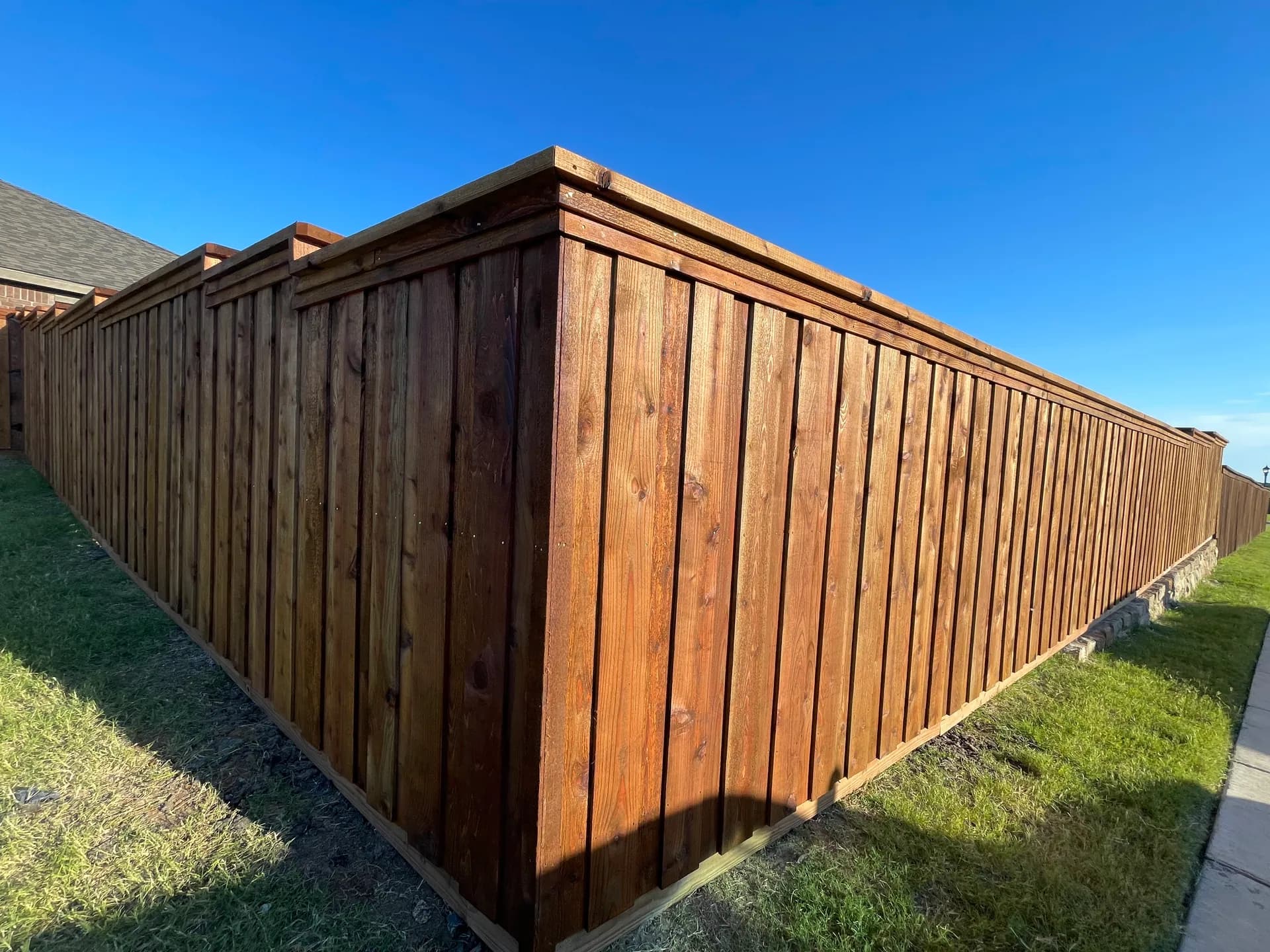
A well-built cedar fence in DFW should last 20–25 years. Most last 10–15. The gap isn't the cedar — it's the install. Here's what makes the difference.
Why Cedar in DFW
Western red cedar is the default DFW privacy fence because:
- Natural rot resistance (oils in the wood repel moisture)
- Dimensional stability (doesn't warp as much as pine)
- Weathers to a silver-gray patina if unstained
- Takes stain beautifully if finished
- Matches the aesthetic of most DFW neighborhoods
The alternative — pressure-treated pine — is cheaper and more rot-resistant to ground contact but tends to warp, check (crack), and look rougher within 3–5 years.
The Lifespan Breakdown
| Component | Budget Install | Quality Install |
|---|---|---|
| Posts | 4x4 pine in concrete to 18" deep | 4x4 cedar or galvanized steel, concrete to 36" deep |
| Rails | 2x4 pine, face-nailed | 2x4 cedar, mortised or bolted |
| Pickets | 1x6 cedar, butt-joined | 1x6 cedar, board-on-board overlap |
| Fasteners | Galvanized nails | Stainless or ceramic-coated deck screws |
| Post caps | None | Cedar caps over every post |
| Trim | None | 1x4 cedar top rail + kickboard at bottom |
| Stain | Year 1 only | Year 1, re-stain every 3–5 years |
| Actual lifespan | 8–12 years | 20–25 years |
The material difference between these two installs on a 200-linear-foot fence is maybe $1,200. The labor difference is bigger. The total price delta is often $2,500–4,500. And you get double the lifespan.
The Five Things That Kill DFW Cedar Fences Early
1. Shallow Post Holes
Texas freeze-thaw cycles + clay soil = post heave. A post set only 18" deep will lift, lean, and eventually fail within 5–8 years. Proper depth in DFW is 36" minimum (below frost line), concrete collar, gravel at the bottom for drainage.
2. Untreated Pine Posts in Concrete
Pine posts will rot at the soil line in 8–10 years regardless of bracket. Cedar posts last longer but also eventually rot. The long-lasting options are:
- Galvanized steel post sleeves (Postmaster, Perma-Post) — 40+ year lifespan
- Concrete with posts set above-grade using post bases — removes wood-to-concrete contact entirely
We almost always run Postmaster steel posts clad in cedar on higher-end installs. 40-year warranty on the steel, full cedar appearance.
3. No Kickboard / Rot Board
Grass clippings, mulch, and standing water at the bottom of the fence soak the lower 4–6" of every picket. Without a kickboard (pressure-treated or cedar 2x6 running along the bottom), the pickets rot from the bottom up within 5–7 years.
4. Face-Nailing Pickets
Air-nailed pickets look fine on day one. By year 3, the pickets are loose and cupping. Deck screws hold through 15+ years of wind cycles. The install takes 40% longer — and the fence lasts twice as long.
5. Skipping the Stain
Unstained cedar: weathers to silver-gray in 6–12 months, loses UV protection, starts splitting and checking by year 4. Lifespan: ~12 years.
Stained cedar (semi-transparent oil-based, re-stained every 3–5 years): maintains color, retains water resistance, holds up 20–25 years.
If you love the silver-gray patina, you can skip stain — but expect 40–50% shorter lifespan.
The Three DFW Fence Styles
Board-on-Board (Standard)
Pickets overlap by ~1", creating full privacy with no gaps when the wood shrinks. This is the DFW default. Most HOAs require it.
Horizontal Plank
Wider boards (1x6 or 1x8) laid horizontally. More contemporary look. Requires steel posts or very beefy vertical supports because the rails have less structural integrity than vertical pickets.
Hybrid Steel + Cedar
Steel frame (galvanized tube) with cedar infill panels. Common on higher-end Southlake / Westlake / Highland Park builds. 50+ year lifespan on the steel, cedar infill can be replaced every 15–20 years independently.
Cost in DFW (2026)
Standard 6' tall, 180 linear ft backyard:
| Style | Quality tier | Price |
|---|---|---|
| Pine board-on-board | Budget | $4,800–7,200 |
| Cedar board-on-board, pine posts | Mid | $7,500–11,500 |
| Cedar board-on-board, steel posts | Quality | $10,500–15,500 |
| Horizontal cedar, steel frame | Premium | $14,500–21,000 |
| Iron + cedar hybrid | Luxury | $22,000–38,000 |
Gates, corners with cut panels, and tie-ins to existing fence add cost.
HOA Approval
Every DFW HOA we've worked with requires architectural review for fence replacement. Board-on-board 6' cedar with matching top rail and kickboard is approved essentially everywhere. Horizontal plank gets approved in most modern communities (Prosper, Celina, parts of Frisco) but not universally (older Plano, most of University Park, Highland Park).
Common restrictions:
- Height: 6' in backyard, 4' in front yard or side-yard street-facing sections
- Material: Natural cedar (unstained or semi-transparent stain) most commonly approved
- Finish: Finished side (smooth face of the pickets) must face outward toward neighbors and street
We submit architectural packages on your behalf as part of the scope.
Maintenance That Actually Matters
- Year 1: Let cedar cure 60–90 days before first stain
- Year 1: First stain (semi-transparent oil-based)
- Year 4–5: Re-stain
- Every year: Walk the fence, tighten any loose screws, clear grass/mulch from the kickboard
- Years 8–10: Expect to replace a few individual pickets if they've checked or been damaged
That's it. No annual sealing, no pressure washing (it drives water into the wood), no heavy maintenance.
Ready for an Estimate?
We build cedar board-on-board, horizontal modern, iron + cedar hybrid, and custom feature walls across 30+ DFW cities. Free on-site measure, written line-item estimate, and HOA submissions included.
Ready to Start?
Free on-site estimate — no pressure.
Typical callback under 24 hours across DFW.